Go Tell the Crocodiles by Rowan Moore Gerety
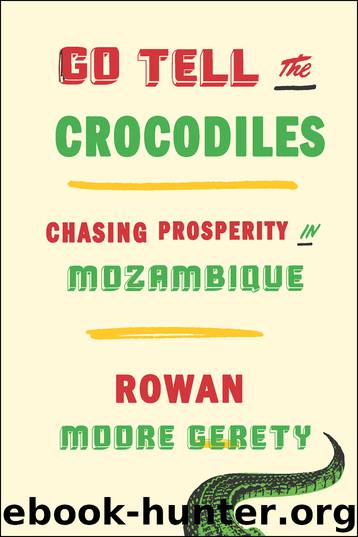
Author:Rowan Moore Gerety
Language: eng
Format: epub
ISBN: 9781620972779
Publisher: The New Press
Published: 2017-12-15T05:00:00+00:00
Juma Raimundo, a Red Cross volunteer who was living in Curuhama, remembers the day in February when the first cholera cases showed up in Mogincual.
The Red Cross had learned of an outbreak spreading in a neighboring district the day before. Volunteers were in the midst of planning a chlorine distribution when people from affected areas began trickling in on foot, terrified at seeing their neighbors racked by fatal, uncontrollable diarrhea. Several people died on arrival.
Raimundo’s village, Curuhama, began to empty out as people fled.15 Those who could afford the fare walked out to the main road and hailed motorcycles and trucks to Liupo. One man from Curuhama told me that even some relatives of those who died fled “like ants before a flood.” Some stayed to assist neighbors and loved ones in burying the dead—with no protective equipment. Others looked for a culprit.
Raimundo mans the health post in Quinga, a picturesque town on a hillside three miles from the Indian Ocean. Once upon a time, under the Portuguese, Quinga was the administrative seat of the district, and the town square is still dominated by the pastel pink and blue skeletons of a dozen or more large art deco buildings, their roofs long gone, with a scattering of tailors and cigarette sellers making use of the shelter afforded by their overhung porches. You can still make out “Tribunal,” or courthouse, written on the facade of one, and imagine “Correios” painted above the entrance of the old post office.
Raimundo waved me inside and had me sit behind the doctor’s desk while a young woman stood on the steps with a tiny coughing baby swaddled in a capulana. When the first cholera cases appeared in Curuhama, Raimundo said, people became uneasy and approached the líder comunitário (community leader) to express their suspicion that the Red Cross might be involved. “‘We’ve lived here for so many years, and we drank the water without becoming sick,’” they argued.
There had been PSAs on the radio there explaining the basics of the disease and spreading prevention messages too, but, if anything, that made people more suspicious. As one young woman participating in a focus group on cholera violence told a sociologist years earlier: “I think the problem is that the radio anticipated that there would be a cholera outbreak this year, which made people say, how can they know a disease is coming on such and such a day?”16
In Curuhama, “When the outbreak began, people felt the Red Cross volunteers already knew it would,” Raimundo explained. The community leader tried to dissuade them from accusations against the Red Cross, but he was beaten up for his trouble. On February 25, the mob grew to something like two hundred young men from Curuhama and surrounding villages, Raimundo estimated, as they burned down houses belonging to volunteers.
The secretary of the Quinga chapter of the Red Cross, Cassiano Muquinone, had gone to Liupo by bicycle the day before to get chlorine water treatment solution—called Certeza, or “certainty”—to distribute. When he
Download
This site does not store any files on its server. We only index and link to content provided by other sites. Please contact the content providers to delete copyright contents if any and email us, we'll remove relevant links or contents immediately.
| Anthropology | Archaeology |
| Philosophy | Politics & Government |
| Social Sciences | Sociology |
| Women's Studies |
The Secret History by Donna Tartt(18977)
The Social Justice Warrior Handbook by Lisa De Pasquale(12172)
Thirteen Reasons Why by Jay Asher(8861)
This Is How You Lose Her by Junot Diaz(6849)
Weapons of Math Destruction by Cathy O'Neil(6235)
Zero to One by Peter Thiel(5749)
Beartown by Fredrik Backman(5696)
The Myth of the Strong Leader by Archie Brown(5477)
The Fire Next Time by James Baldwin(5399)
How Democracies Die by Steven Levitsky & Daniel Ziblatt(5186)
Promise Me, Dad by Joe Biden(5122)
Stone's Rules by Roger Stone(5060)
A Higher Loyalty: Truth, Lies, and Leadership by James Comey(4927)
100 Deadly Skills by Clint Emerson(4893)
Rise and Kill First by Ronen Bergman(4749)
Secrecy World by Jake Bernstein(4714)
The David Icke Guide to the Global Conspiracy (and how to end it) by David Icke(4667)
The Farm by Tom Rob Smith(4479)
The Doomsday Machine by Daniel Ellsberg(4464)
